I left my house earlier this afternoon to bike down to join what I thought was going to be a peaceful protest march for Palestinian liberation. I had been organizing my thoughts for an upcoming songwriting session I would be leading on the themes of resilience and movement. It seemed a reasonable way of modeling what I believe to join together with other people in the spirit of acts of resilience in large numbers to create cultural movement and change. In these times of ever increasing turmoil and polarization, it feels urgent that we find ways to see and hear one another, to support those whose voices are not being heard, and to step outside our comfort zones at times to stand up for human rights.
My experience with humanity was a bit fraught from the start. While biking down a busy Seattle thoroughfare, I noticed a woman standing in the middle of the bike lane in a crosswalk. She was looking down at her phone, so I quietly said, “Excuse me.”
“You can go around me,” she snapped in response. I had already gotten off my bike to avoid running into her. I had assumed she hadn’t seen me, and I admit I was floored to realize she was intentionally blocking my path. In all transparency, I had biked through a red light because there were no cars crossing the road. Had she noticed? Was she triggered by this? When I talked with my husband about it later that day, he suggested that I did not even show up for her. Bike lanes and cyclists were not part of her sphere of awareness or interest. She was wrapped up in her own world.
In the moment, I responded, “You could be friendlier” and then continued on my way.
This kind of experience would not have been surprising if I had been in or around Boston, where I grew up and where I lived and worked for nearly three years in the early 2010s. Thankfully, this still happens infrequently enough in Seattle that it took me by surprise. I intentionally try not to engage in petty, aggressive behaviors or make nasty comments, which can feel deliciously justified and like some small victory but in the end only serves to perpetuate unpleasant energy and anger.
I don’t want to be angry. It doesn’t feel good, and I want to try to shift this tendency toward a trite response to seeing the good in other people. Or at least to not take their actions personally or in a way that warrants a response. Pettiness is easier in the shorter term but breeds animosity.
Case in point, the interaction and the negative, angry energy coming in waves off of this person and directed, albeit briefly, toward me, left its mark. In yoga, this mark is called a samsara or samskara. Over time, these marks can build up and create a murky lens through which we view the world. If I had to guess, I would imagine that this person was bowing to anger grown over time up by many, many samskara blurring her lens and affecting how she viewed other people. As usual, as I biked on I ran through the interaction again and again into head, thinking of different ways I could have responded, wondering if someday I might get to a point in my own personal development where I don’t feel a need to respond or engage. I know from years of experience working in customer service, therapy, and studying nonviolent communication that it is not my job to change or fix this person. I also know that her behavior likely had very little to do with me and more to do with her being triggered by my action. I still wished there was some way I could have responded that might have shown light on our shared humanity. I wasn’t her enemy, and I wanted her to know that.
Maybe I could have tried saying something to that effect. “You don’t have to be angry at me. I’m not your enemy.”
I am clearly still at the point in my own development where I feel triggered and unable to stop myself from responding. Perhaps, I can at least try to say something nice instead of condoning petty behavior by behaving in kind. I felt awash in ickiness and hoped the rhythm of cycling would work its magic on my nervous system. By the time I found the gathering place for the march, I was feeling more grounded. My hope was that the group might not have left the area, and this was the case. As I dismounted from my bike and walked into the small park through a side entrance with a small paved walkway, a person was speaking into a microphone to a small crowd of people wearing keffiyehs and waving Palestinian flags. His words seemed peaceful enough. I opened my bike bag, donned my own keffiyeh to show my solidarity, and then began walking around the outer edge of the crowd in search of a shaded spot where I could cool off. Literally, I felt good about my choice to be present in a show of peaceful solidarity. I think where the shift began for me was when a subsequent speaker began celebrating the acts of violence from October 7 two years ago.
Let me be clear, I am not a Zionist, and I also do not condone any acts of violence, especially not toward people who are unarmed and in the sanctuary of their own home. I know there are many people living in Israel who are not anti-Palestinian and do not support occupation.
With this speaker’s rhetoric, I began to wonder if I was safe as a Jew in this space. I don’t necessarily think of myself as looking super Jewish, but I also recognize that I don’t not look like a Jew.
I texted my husband: “I found the march group. There are people speaking. I think it’s a little in poor taste to celebrate the attacks in on Israel on October 7. Or referring to our “enemies” as “bloodthirsty demons.” Not really my jam.”
My husband responded, “Ugh.”
I also noticed that I was starting to feel physically ill and what I can only describe as “gross” being present amid this kind of energy. It was the “bloodthirsty demons” comment with regard to anyone who supported Israel—politicians, corporations, etc.—that pushed me over the my edge. ” I decided that I had heard enough. I walked my bike back the same way I came in, took off my keffiyeh and tucked it into my bike bag, and headed for home.
While waiting at a crosswalk, I texted my husband again.
Me: “I’m heading home. I feel really sad about humanity right now. Why am I even studying Arabic?”
He was swift to respond: “So you can have those cross cultural dialogues.”
Me: “Oui. Ok. These are not spaces for that.”
It did seem like an interesting coincidence that my second Arabic class was scheduled to begin this evening, on the two year anniversary of the October 7th attacks by Hamas on Israeli citizens.
As I biked home, I found myself once again running the experience over and over again in my mind. This tendency can drive me a bit nutty and falls into the OCD fixation realm. It can also help me to process how and why an experience left me feeling so uncomfortable. For one, this protest did not feel reminiscent of the civil disobedience of Gandi or the Civil Rights Movement.
The gathering felt like a space for people who were already angry at corporations and the police to find another avenue to vent their frustrations. How informed were the protesters about the complex history of the region am by no means an expert, but I know it is another area of humanity that is fraught and not easily boiled down good and evil.
As I put foot to the pedal, I realized that I also felt uncomfortable because I wanted to protest the violence but I wanted to do that by opening my heart rather than directing anger and blame. I want to shift training that leads me vilify other people and replace it with the desire to find places where our humanity overlaps, where we have common ground. For one, it seems counterproductive to perpetuate hatred. Also, labeling people who have different beliefs and values from us as the “enemy” would seem to dehumanize them and justify acts of atrocity in the ways that have historically led to genocide. An eye for an eye, as it were.
I found myself passing judgment on the people gathered and speaking at the event, and I tried to change this line of thinking. As one of my recent therapists told me, “Everyone is on their own path. Everyone gets to have their own experience.” If this way of protesting did not sit well with me, I could decide to leave and protest a different way.
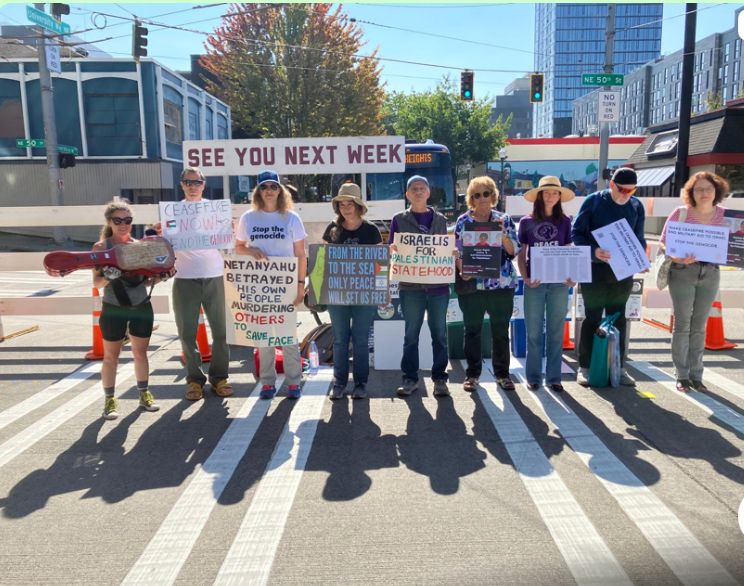
I have joined some small gatherings to protest the war against Palestine. I often feel uncertain about how I will be identified by people at the protest. Will they see me as a Jewish person who is unwelcome? I biked down to the U-District market a few Sundays ago and stood together with Israelis against occupation. I brought my ukulele and even played a couple of songs I wrote with asylum seekers from Gaza. This gathering was small, but I felt welcome and that my presence was promoting peace as opposed to perpetuating enmity.
One of my yoga students shared an event called “Hands around Greenlake” gathering last weekend, which felt very heart opening and much more in my wheelhouse, but I didn’t get there in time after getting the dates mixed up.
In this time of ever-increasing polarization and enmity of the perceived “other”, I want so deeply to bring more love and humanity in the world. I often feel paralyzed as to where to begin. I suppose one must start somewhere, however small, and expand from there.
Protest can take many forms, and for me, there are many ways to hold space for human connection and healing. Singing, teaching yoga, caring for my family and friends. These all have a rippling effect, and we don’t always know how the seeds we plant take root and flower.
I have dear friends from Gaza who have family that still lives there. I met most of these people during my time volunteering at a refugee asylum center in Brussels, Belgium. This was the space where I feel I can do the most good in peaceful protest and in pursuit of finding shared humanity.
From January 2017 through March 2020, I volunteered to offer weekly sessions on Monday afternoons with a poet and writer who has become a dear friend. We put big pieces of paper up on a wall on an outdoor, covered corridor and invited residents to shares words and phrases in any language from their migration experiences, which we collaboratively shaped into poems and songs. The people we met were required to remain at the center while they waited for a response to their asylum applications. In this liminal space, we created connection and community and art from some of the darker sides of humanity.
What struck me time and again was the profound hope for humanity that wove its way into these songs. Wishes for an end to borders, for people to never give up. One song we created with asylum seekers from Gaza and Syria began, “I am a word of hope and love.”
Another from a father who brought his family from Gaza to Belgium wrote, “I brought my family here to make a new start. I want my son to grow up without hate in his heart. Salaam, Shalom, Salaam, Shalom.”
Rather than making the whole blind, may I continue to find ways for people see each other as through a lens of humanity, as worthy of love and a peaceful life.
In shallah, may it be so.
 life of m